
The Gap
The Space Between Inclusion and Jewish Exclusion
by Jen Kogan
Recently, I was combing through Etsy shops searching for Judaica for my new home. All at once, I was confronted with some extremely disturbing images: red triangles, juice boxes and calls for violence printed on t-shirts, stickers, bookmarks and lawn signs. I felt shocked because as I explained I was looking for Judaica.

What struck me was not just the content itself, it was that many of the items appeared to be inconsistent with Etsy’s own policies. I looked those up and sure enough they were. So I followed the reporting process, carefully documented the items and shops, attached an appendix, and submitted a complaint. Then I waited. A week went by with no response. I followed up with another letter. And then a familiar recognition hit me.
Oh. They’re probably never going to get back to me.
I had experienced this before. For nearly three years, I, alongside Andrea Yudell and many other Jewish social workers, have repeatedly attempted to engage the National Association of Social Workers (NASW) about virulent antisemitism and antizionism within the profession and the organization itself. We submitted letters, petitions, reports, testimony, and repeated requests for dialogue. Again and again, we appealed to NASW whose values include dignity, inclusion, cultural humility, and respect. They never got back to us.
Jennifer Freyd, documented the harm that occurs when institutions fail those who depend upon them describing a phenomenon known as institutional betrayal. The concept helps explain the injury many Jews experience when organizations violate their own stated commitments.
Sociologists have long recognized that organizations sometimes become detached from their own policies and procedures, a phenomenon known as organizational decoupling. This usually references the internal processes of an organization versus how they treat the outside world. I use the term somewhat differently. Decoupling is how I describe the mechanism by which institutions detach from their stated commitments when responding to Jewish concerns.
At first glance, Etsy and NASW seem to have little in common. One is an online marketplace. The other is the largest professional association for social workers in the United States.
In neither case was I asking the institution to adopt new values. I was asking it to uphold the values it already claimed to embrace. That realization led me to a question: What is the distance between an institution’s stated principles and its actual behavior?
I call that distance The Gap.
Up until now, my focus has often been on the individual incident. Was a particular act antisemitic or antizionist? Did someone intend harm? What were their motives? The Gap asks a different question:
Does the institution behave in accordance with its own stated values?
Many institutions have effectively decoupled their commitments to inclusion from their actual treatment of Jewish individuals and communities. The Gap can be understood as the distance between an institution’s professed values and its actual treatment of Jews.
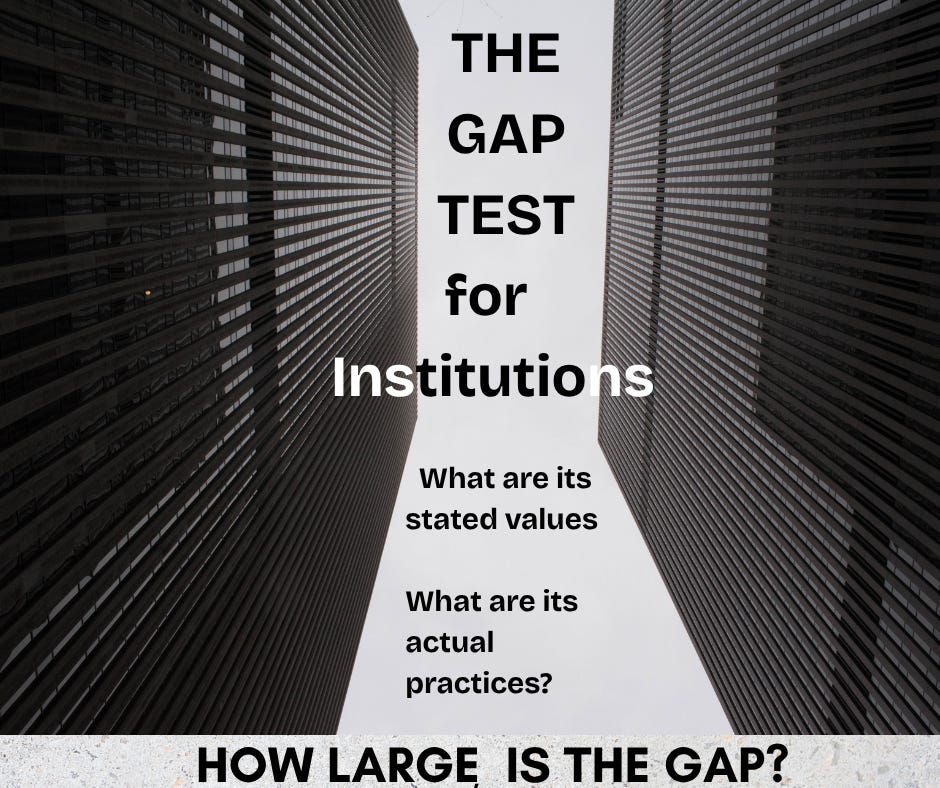
The Gap takes many forms:
Historically, Jewish quotas exposed a gap between meritocratic ideals and admissions practices. Many country clubs, social clubs, and professional institutions maintained formal or informal "No Jews Allowed" rules while publicly presenting themselves as fair, respectable organizations.
Academically, theories developed to understand oppression reveal a gap when the framework itself denies and condemns the Jewish people themselves.
Institutionally, universities may speak the language of inclusion while Jewish students are excluded.
Clinically, therapists may value empathy, compassion and our mental health codes of ethics while applying frameworks that invalidate and dehumanize Jews.
These examples all point to the same phenomenon: a disconnect between professed principles and lived reality.
Many Jews describe feelings of confusion, betrayal, exhaustion, and loss of trust after interacting with those institutions that publicly embrace inclusion and anti-discrimination.
So we write letters because we assume this gap is a misunderstanding that we can clear up. We think: If I explain it better, they’ll understand or, If I provide more evidence, they’ll respond. Realizing that there is a structural gap changes the calculation.
We can stop asking: Why didn’t this particular letter or action work? And start asking: Why does the institution repeatedly fail to bridge the gap between what it says and what it does?
Should we persist in fighting for equal treatment within these systems?
Purpose 1: To effect change
For example, if the goal is to get NASW leadership to suddenly engage after years of nonresponse, or to get Etsy to meaningfully enforce policies after repeated reports, then you have to ask yourself honestly:
What evidence do I have that this institution is capable of responding differently?
Not what it should do. What it has actually done. This suggests looking at behavior rather than hope for a different outcome. Once that is clarified, other avenues for accountability can be considered.
Purpose 2: To create a record
Sometimes letters are not primarily for the recipient. They’re to document concerns, create a paper trail, to demonstrate that people spoke up and to help future readers understand what happened.
Examining The Gap within systems and institutions saves our precious energy so we can focus on more meaningful action.
COMING SOON
Part 2: What actually changes institutions?
I love the way you articulated this phenomenon and I look forward to reading more.
I’m really stumped as to how (or whether) to respond to an email the City of Boulder sent to all city employees on the anniversary of the June 1 terrorist attack.
It was several paragraphs long and didn’t mention the words “Jew” “Jewish” or “Jewish community” until about halfway in.
A city that claims to be inclusive shouldn’t have a hard time stating “We stand with our Jewish neighbors” — but apparently they do.
Thanks Jen . I really like that analysis